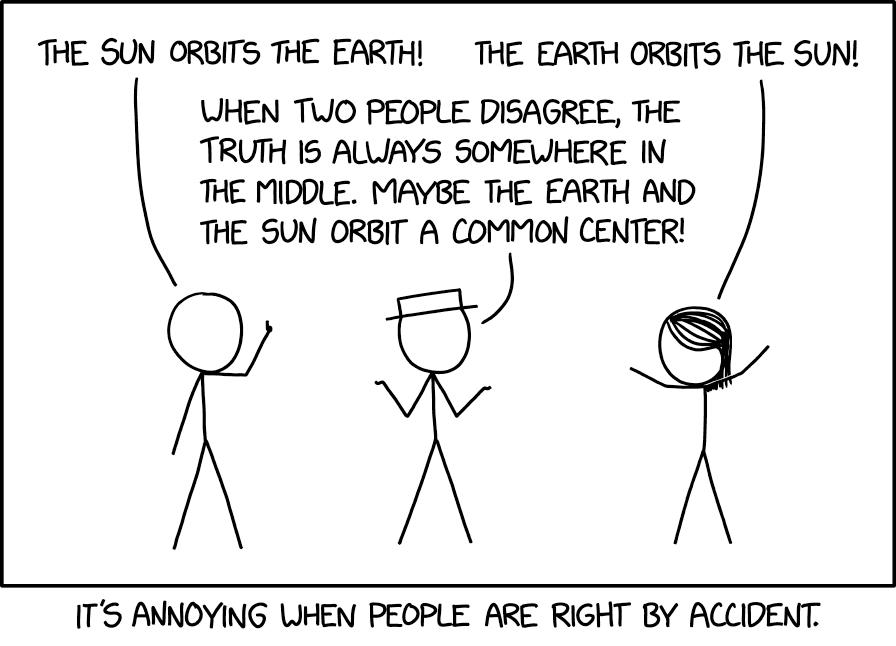
Alt text:
“Some people say light is waves, and some say it’s particles, so I bet light is some in-between thing that’s both wave and particle depending on how you look at it. Am I right?” “YES, BUT YOU SHOULDN’T BE!”
You must log in or # to comment.
And that point is inside the sun.
No actually. Due to Jupiter, the centre of mass of the solar system is actually very slightly outside of the sun
Leave it to Jupiter to mess yet another thing up
Stupid lazy ass diabetus planet doesn’t even have enough mass to fuse its hydrogen.
Wouldn’t the center of mass constantly be shifting by the planets’ varying positions in orbit?
Yes, but it’s mostly shifting because of Jupiter. It’s just so dang heavy. Like, a couple times heavier than every other planet put together. I don’t have the brain wattage to do the cool math right now, but a quick google search says that while the barycenter of the solar system does depend on all the planets, more often than not, it is outside the sun
Cool. I learned something today
Wait I’m sorry, are we saying that the earth’s orbit isn’t almost entirely dictated by the gravitational pull of the massive star at the center of our solar system? I am a simple man, I apologize if that is a stupid question.
When dealing with gravitational systems the gravity of each object has to be taken into account. So even though the sun is 99.999% (hyperbole) of the gravity in the equation, the earth’s gravity contributes that small 0.001% and thus the “center” of where they orbit isn’t truly the center of the sun. Tack on Jupiter, which is much more than a fraction of a percent and that “center” moves even farther away from the middle of the sun.
To look at it further, if you had two objects of perfectly equal mass and no other gravitational interference, they would orbit around a point in the middle of each other since their pull is equal. So it’s basically a sliding scale of sorts.
Hope that explains it!
No the comic is pointing out that the sun and the earth are both orbiting the milky way galactic center.
Edit: While also true, I was wrong, they orbit the center of mass of the two body problem (earth and sun). I still think that’s too simple of a way to look at it. It’s not a two body problem and the other planets and the whole galaxy are also in play.
I mean technically every body in the entire universe exerts gravity on everything else as long as it’s in your light cone
What’s a light cone?
A not too heavy cone.
Apply that to the flat earth debate and you get an oblate spheroid.
This comment should be deleted soon
You’re an oblate spheroid

I appreciate the origin story being included in this cliché, cuz it got repeated so often on Reddit that people seemed to forget it was said by a parody of an obnoxious heartless bureaucrat and repeat the phrase without irony.
You know, you are technically correct.
I mean, no, not really. The gravitational center of the sun-earth system is within the sun itself, so the earth definitely orbits the sun and the sun definitely does not orbit the earth. Let alone the fact that the sun’s movement is predominantly driven by Jupiter. (The gravitational center of the sun-Jupiter system is just above the sun’s surface.)
Except that any two gravitational bodies orbit a common center…
The Earth orbiting the Sun causes the sun to wobble slightly, moving its orbital center away from its center of mass, which means the sun and earth actually orbit a common center point no?
Even if that center point is within the other body it still isn’t the center of that body, therefore they both orbit a shared gravitational center that is not the center of either body.
I would not call it orbiting if the center is within the body. So, since the center of the sun-Jupiter system is just outside the surface of the sun, I would say the sun and Jupiter orbit the center of their system, but since the center of the sun-earth system is within the body of the sun, I would not say the sun orbits the center of this system. The path the sun takes in this system is entirely contained within its body.
Now, since the sun, Jupiter, and earth are all in the same system, there’s even less reason to say the sun orbits the earth, since the earth has a negligible effect on the sun’s motion.
Just because you believe that a negligible effect means that it shouldn’t be called orbiting doesn’t change the fact of the matter that there is still a shared gravitational center that both bodies orbit around…
It doesn’t matter if it’s negligible or not, the fact of the matter is that such a point exists and both bodies orbit around that point.
Then literally everything is orbiting literally everything else, and the word orbit is completely useless.
I have a gravitational effect on the earth. The earth-hperrin system has a gravitational center that both bodies revolve around. Does that mean the earth and I orbit that center? No, because my effect on the earth is negligible. The absolutely immeasurably small wobble my mass gives the earth is not an orbit. There are bodies much more massive than me that the earth orbits (despite how many Doritos I eat).
To put in less hyperbolic terms, Mars’ moon Phobos and Mars have a gravitational center, deep deep deep within the Martian core that both bodies revolve around. Does that mean Mars orbits this point? I don’t think a reasonable person would say so. A massive body wobbling because of a small body orbiting it is not orbiting. Only one thing in such a system is orbiting.
It’s called a barycenter, kids, a common center that both objects circle around. That common center happens to be inside the sun, but that’s a topic for next week’s class in this semester’s AP Astrophysics program.
I don’t think the barycentre is inside the sun? Wikipedia says on the barycentre article:
When the less massive object is far away, the barycenter can be located outside the more massive object. This is the case for Jupiter and the Sun; despite the Sun being a thousandfold more massive than Jupiter, their barycenter is slightly outside the Sun due to the relatively large distance between them.[2]
I don’t think the barycentre is inside the sun?
The Jupiter-Sun barycentre in outside the sun.
The Earth-Sun barycentre is inside the sun.
Fallacy fallacy taken to its logical conclusion.
Is this… an introductory course in relativity, disguised as a joke?
Am I accidentally learning something here?
Guys?
xkcd
yes it is
Technically, the sun is pulled by the earth too so it’s sort of true.
I mean, yeah. That’s the joke.
Oh thanks! I wasn’t sure. /s
May as well lose the /s
No it’s not. The common center here is the center of our galaxy which both orbit. Even if the sun wobbles a miniscule bit there is no common orbit between them.
As a middle ground kind of guy, I would like to pre-emptively state that a lot of us don’t actually think the answer is always the middle ground between two stances. It’s just that we’re more likely to propose a middle ground solution because we evaluate the plausibility of both stances in a more balanced way (as opposed to existing-stance-holders who are prone to bias towards their own stance.) When the two seem roughly equal in plausibility (which happens fairly often, otherwise the argument would be more one-sided,) that’s an indication to evaluate the middle ground as well.
Middle ground folks are often caricaturized as wanting to find the middle ground between an objectively sensible point A and a radically wrong point B, when the spectrum of opinions is sort of like [ - - - - - A - | - - - - - - B ]. In that caricature, we’re looking for a middle ground at point C [ - - - - - A - | - - C - - - B ], when in actuality we’re evaluating (and not automatically accepting) something two or three steps closer to A. In some such cases, A might already be the most sensible middle ground.

Middle of the ground people are mostly cowards too scared of conflict, or devoid of insight.
Maybe there’s a middle ground between our two views.
Why are you so scared of conflict?
I’m not scared of conflict, I’m averse to needless conflict. I may get involved in a conflict for the purpose of breaking it up, or I may initiate a conflict for a good cause such as combating hatred and averting future conflicts - if I feel it’d be productive.
Great reply but… I was being facetious; making fun of the guy you were replying to 😁
I figured.