

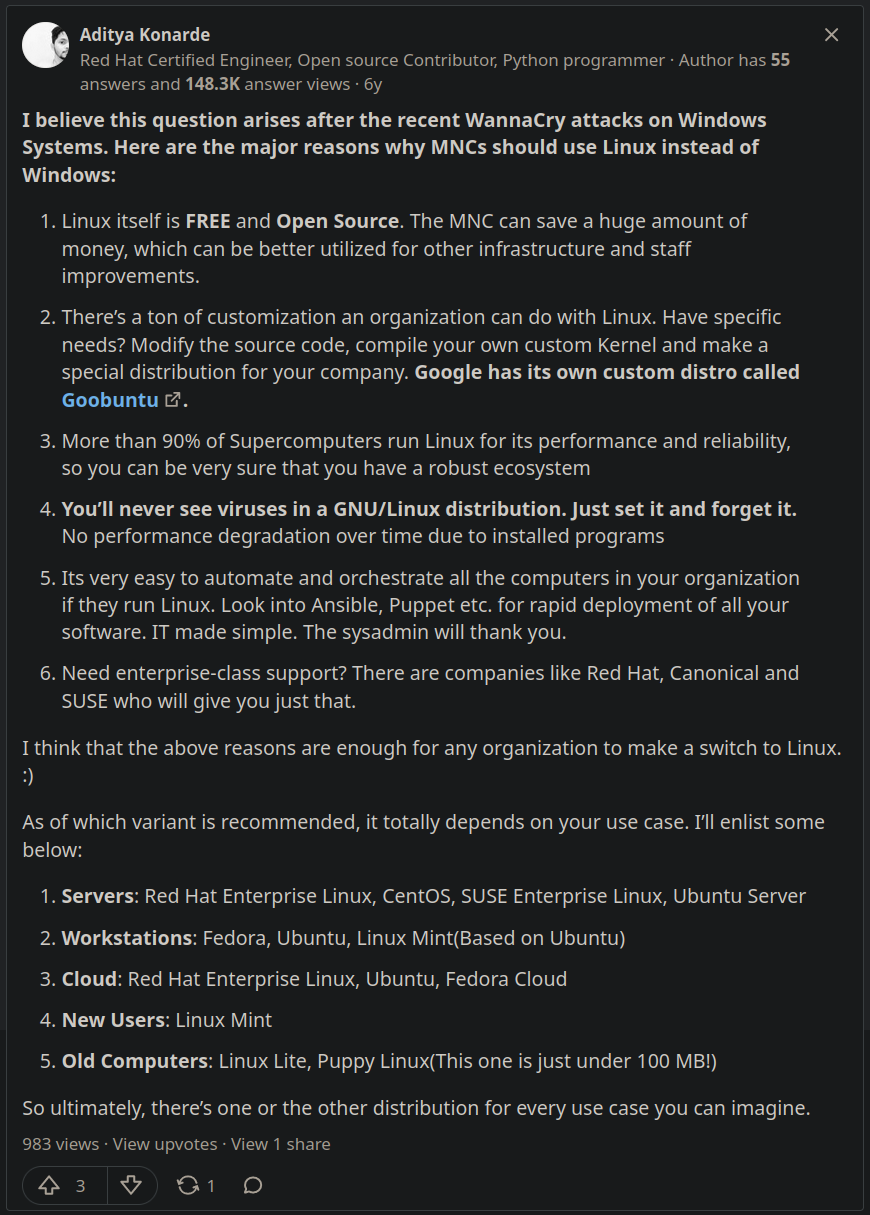
I’m just tired. On the last post about having Linux at our work, many people that seems to be an IT worker said there have been several issues with Linux that was not easy to manipulate or control like they do with Windows, but I think they just are lazy to find out ways to provide this support. Because Google forces all their workers to use Linux, and they have pretty much control on their OS as any other Windows system.
Linux is a valid system that can be used for work, just as many other companies do.
So my point is, the excuse of “Linux is not ready for workplaces” could be just a lack of knowledge of the IT team and/or a lack of intention to provide to developers the right tools to work.
deleted by creator
Yeah for a “red hat certified engineer” that seems like a weird hyperbole to die on
Well, there are virus as any kind of device that runs any logic, the thing here is that is harder to get hacked than with this kind of tools that Windows uses.
And I mean getting viruses like this:
So yeah, I don’t need many apps that my Mac has and could be used to hack me with 0 click interaction or with valid Windows certified programs. Still, the “no virus” is not the only reason, updating a Linux system is just a few seconds and your work could have their own repository mirrored and monitored.
On Linux -> https://arstechnica.com/security/2023/09/password-stealing-linux-malware-served-for-3-years-and-no-one-noticed/
(not a virus directly from a package manager or distro tho).
However nothing prevents someone from hosting malware on github, or fake “safe” distros.
There can also be a slip and people not seeing a project turned into malware.
I know about this issue, I have read about it already. No one uses this unless noobs watching YouTube tutorials.
Cannot be compared to the vulnerabilities I pasted (0 click exploit). Any system can be hacked, Linux is the most used OS and still have fewer viruses issues as others, but it still has as any system has.
The linux kernel is not completely secure by default, neither is any specific distribution. No internet connected device could possibly be “set and forget”. Security can not be taken lightly
Yup, that is right, any device can be hacked.
Wtf are you talking about. Linux isn’t a distro.
And the example isn’t a “only noobs use it”.
It’s an example of an exploit existing since many years. And which could have appeared in a random package, while staying invisible.
I said distro instead OS, Linux is the most used OS, many people behind working in secure the Linux environment. The example of this exploit also exists on Mac and Windows for years, and it will always happen.
An admin user will know what they are doing, and I doubt they will install a package from an external source downloaded randomly on internet, for the non-admin users, without sudo they can’t install/infect that malware on your Linux.
Wrong, Linux totals 3% of the desktop market which is what’s being discussed in the original post.
Many people work on securing Windows so your point is…?
Whataboutism.
Wrong. This is so wrong. The most common and effective attacks start with phishing people who think they know better. A user downloading a zip or rar file is enough, they don’t need to be an admin or have sudo rights.
Seriously just stop talking about a topic you have zero knowledge on. I suggest you do a SANS course if you’re actually interested in learning.
There are more servers than users in this world, even your car runs Linux.
Yea given that Linux servers are already commonplace it is clear you were referring to Desktops.
You’re garbage at this, the worst kind of advocate Linux could have.
But it’s kind of true in practical experience. Show me one Linux virus that spread and made its way through some network.
I can show you more than i have fingers that have been affecting windows.
When it comes to workplaces, you can expect people to deliberately craft a virus and/or try that break into your system specifically. A lot of the world runs on linux, a lot of hackers try to break in to this world.
For personal use it may be true enough to be fine in practice, but it’s a very dangerous thing to believe for a professional setting with probably expensive equipment and valuable data.
Yeah. I know that. But that’s in theory. And it’s more hacking, not a virus.
If that’s really true, it’s surely possible to find an example of a virus that did it’s thing (spread) and do a bit of damage somewhere. And not just say hypothetically it’s true.
I know Linux can be hacked, because I had a webserver hacked. And i see all the logs and the hundreds of login attempts per second and automatic exploits in my logfiles. I have a good idea why most of the Linux boxes get hacked. And all I’ve ever seen were not updated server software resulting in rootkits. 0% is viruses in my experience. Rest is proper issues and maybe the bad guys have been quicker than you. But it’s mostly targeted and rare. And nothing compared to the stuff the windows guys had to deal with during the last year and switch off things until it had been patched properly. We mainly do our updates. And every few years there is a major screwup and you type in a few commands in the terminal to hotfix something. But that’s mainly it. And you can’t make it about any hypothetical issue. While there are supply chain attacks for example, my mom who is using Linux to write her letters and print forms is unlikely to need to learn about that. I told her she doesn’t need antivirus and viruses and trojans are more an academic thing with Linux. She doesn’t need to worry. I also talked about targeted attacks and being a valuable target. But that’s besides the point here. Hence my question and me wanting to stay on point.
Please just prove me wrong. I’m serious. All I could find are some harmless viruses from 2003 that didn’t even spread enough to have reliable numbers. Ransomware that affected ‘tens of users’. And you got the easy position. I advocate for Linux on the desktop. And it’s impossible to prove something is secure. I always have to go into detail, explain viruses, architecture, package managers etc to get my point across. You got the easy position. All you need is to find one counterexample.
And arguments are always the same. I do the whole talk and then say you don’t need antivirus because in real-life there are no viruses. And people ask me ‘but what if tomorrow there is one’. And sure. Nobody believes me when I say I’ve had a quick glance into the future with my crystal ball. But what kind of argument is that? What if I’m struck by lightning on the way home tomorrow if I take the bus instead of the car? I guess I’ll just die then. Many people have been under the influence of ‘windows-truths’ for too long and can’t imagine another world. Some people didn’t listen to the first part of my talk. And some just want the computer to work and a simple answer. I get all of that. But it doesn’t make something true or false.
[Edit: Sorry, had to post this again. I deleted the previous comment by accident instead of editing it what I was trying to do… And Lemmy doesn’t seem to federate deletions that quickly. I’m still learning things here…]