

4·
9 days ago
my name is Edgar Caule, but you can call
me edgy.
yeah, i looked for old data,because my whole point was the early adoption of internet usage which might translate into preferences of the old web and by extension to the fediverse.
i edited my post to reflect that, thanks for the feedback :)
this part is about the early adoption hypothesis, and relies on one (!) table about the internet usage in Europe from 2000 to 2007
https://www.researchgate.net/figure/Internet-usage-in-Europe-2000-2007_tbl9_4891139
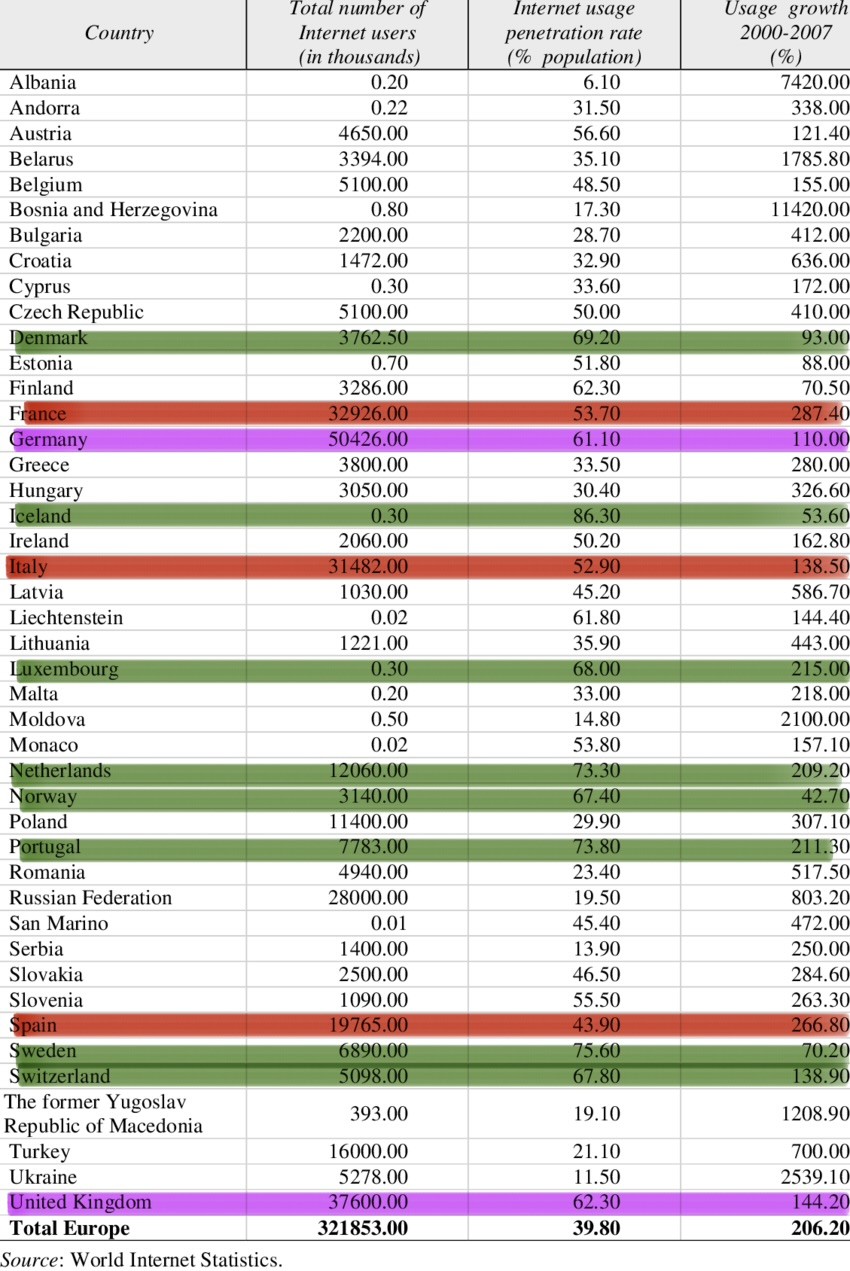
we can distinguish a few groups:
as we can see from the statistics, Germany is sporting the biggest total amount of internet users relative to the other European countries.
another relevant aspect is the percentage of growth, and Germany has one of the lowest growth rate compared to other countries while having a high percentage of users, which implies an early adoption of internet users.
linear regression could probably be used to find the relation between wealth and internet usage.
the case of Portugal is really interesting though, as it’s a less wealthy country but sporting a high percentage of internet users. Maybe there was some government subsidies?
HANS, GET ZE SPAMWERFER!
Also i think it’s because of germans having a bigger notion of data protection and that huge corporations are bad, which is why a lot more people are changing from reddit to fediverse.
in my personal experience, i can only compare it to spanish people, and i definitely see a lot more concern in german people.
another reason might be economic wealth, having the strongest currency next to the pound in the 80s and 90s, this could mean that early adoption of PCs and dial-up was more spread than in other European countries because of the relative cost difference of equipment.
This early adoption could also mean that more people got to know the ‘old web’ and are more appreciative of non-standardised web content.
it’s only hypothesises, i have no data to support it (yet)

in 5 years from now there’s going to be totally coevolved but unique seed-lines for software. the once with AI, and the once without. how can you distinguish them? did the human that said it wrote them really write them? these problems aside, i suspect it will be forced to happen just from a security viewpoint, big companies won’t be able to get any kind of insurance anymore running AI-infested code.


the article gave me the impression that Valery Kimov was sent to the gulags around 1934.
But this was in 1983!
https://postsoviet90s.com/artifacts/k-chitateliu?thematic_tags[]=gay+prisoners

e-ink screen! i adored the motorola-f3 with the led segment screen

let’s repurpose some old satellites! no copyright jurisdiction in space

yes, exactly my thoughts. what if the AI-slop pull request onslaught is a way of the feudalists to weaken the FOSS community and on the long run make themselves irreplaceable? seems to be happening to a lot of maintainers
i’ve had a similar experience, at first it was incredibly soapy to me. now i genuinely like it and i don’t taste the soap anymore. how could that work though if it’s a genetic trait? could this be stronger in some variants of cilantro? or even on the culantro/cilantro divide?
awesome, thanks for the recipe!
will try this soon.
you might also like farinata di ceci (chickpea-flour chips) (clickable)
what is Walter White doing in this cartoon?

i try not to use AI too often, but when i do have a question i like the interchangeability of the models, so when I feel that one model is too lobotomised to get my question i change it for another and compare it. i trust what ddg says about respecting privacy, i don’t trust the backend llm suppliers though, i don’t have any illusions about that.
i also think the premium through duck.ai option could be interesting if you are a professional user because it still offers the interchangeability option.
but still, it should not be integrated on the main search page, and search should be revamped. normally the first results i get are for some social media presence of a restaurant somewhere halfway around the world instead of the wikipedia article on the main subject that made the name famous in the first place.
also the domain owners of duck.au, duck.si and others are getting a lot of traffic