
I recently switched to Linux (Zorin OS) and I selected “use ZFS and encrypt” during installation. Now before I can log in it asks me “please unlock disk keystore-rpool” and I have to type in the encryption password it before I’m able to get to the login screen.
Is there a way to do this automatically like with Windows or MacOS? Zorin has biometric login which is nice but this defeats the purpose especially because the encryption password is long and tedious to type in.
Also might TPM have anything to do with this?
EDIT: Based on the responses I have to assume some of you guys live in windowless underground bunkers sealed off with concrete because door locks “aren’t secure against battering rams”. Normal people don’t need perfect encryption they just want to add an extra hurdle or two for the crackhead who steals the PC. I assumed Linux had a system similar to what Windows or MacOS has been doing for a decade but I am apparently wrong.
It’s disappointing to see so many commentors arguing against you wanting to do this. Windows has it through bitlocker which is secured via the TPM as you know. Yes it can be bypassed, but it’s all about your threat level and effort into mitigating it.
I am currently using a TPM on my opensuse tumbleweed machine to auto unencrypt my drive during boot. What you want to do is possible, but not widely supported (yet). Unfortunately, the best I can do is point you to the section in the opensuse wiki that worked for me.
https://en.opensuse.org/SDB:Encrypted_root_file_system
If you scroll down on that page you’ll see the section about TPM support. I don’t know how well it will play with your OS. As always, back up all your files before messing with hard drive encryption. Best of luck!
Windows is no baseline for security lol
Sums up about every thread asking how to do something on Linux, 30 different responses on how the OP is wrong and shouldn’t do it that way.
To be fair there are probably many different ways to solve the problem. I’m somewhat experienced with Linux and I’ve attempted seeing up TPM LUKS decryption on boot. It’s certainly not easy or at least wasn’t when I tried. For non experienced people it’s easier to just enter the password at boot and enable auto login. Then you get the security, software, ethics, or licensing debates that accompany most Linux discussions.
Thanks, Zorin is based on Ubuntu so I have to assume it will be up to date with stuff like TPM which is 15 years old. The data on the page you linked is pretty advanced for me but I’ll give it a shot. Appreciate you addressing my question.
Ubuntu isn’t really on the cutting edge, so I’m not sure how well its going to work. Opensuse tumbleweed is running pretty much the latest everything, so its possible youll need to wait until the next Ubuntu lts
Yeah, holy shit is this comment section toxic. Why are people downvoting for someone asking for help and not being a dick?
Is this whole community like this? Are the mods okay with this behavior?
Kinda curious as to the point of drive encryption if you just want it to automatically unlock on boot.
Encryption makes it more difficult to copy data from the drive. Windows and MacOS can manage to encrypt drives without requiring two different passwords, I mistakenly assumed Linux could too.
If you’re having it automatically unlock the drive at boot, it kind of defeats the purpose. If someone steals your tower, they can boot it and copy the unencrypted contents since it automatically unlocks.
OP isn’t asking for it to decrypt automatically. OP is asking for the entering the decryption password to also log you in. That way you only have to type the password once, instead of twice.
GDM has an autologin feature, OP should use it.
I dont think you can. Can you read SSD storage while that is running? The drive needs to be decrypted using the TPM, and that should only work when its plugged in.
It depends on where the encryption data is stored. If the bootloader and bios/efi are locked down and the data to unlock is stored in an encrypted enclave or one is using a TPM (and not an external chip one that can be sniffed with a pi), that’s a reasonable protection for the OS even if somebody gains physical access.
You could also store the password in the EFI, or on a USB stick etc. It doesn’t help you much against longer-term physical access but it can help if somebody just grabs the drive. It’s also useful to protect the drive if it’s being disposed of as the crypto is tied to other hardware.
Even just encrypting the main OS with the keys in the boot/initrd has benefit, as ensuring that part is well-wiped makes asset disposal safe®. Some motherboards have an on-board SDCard or USB slot which your can use for the boot partition. It means I don’t have to take a drill to my drives before I dispose of them
How would they be able to copy the unencrypted contents? They still can’t do anything without logging in.
By intercepting the key on hardware level
Perfect security doesn’t exist. If they’ve got the engineering capital required to design and manufacture key retrieval hardware, you lost the moment they gained physical access to your equipment.
I agree. Physical access to the device and its often game over.
Sadly reading off the key is already trivial in some cases as showcased in this recent video by stacksmashing
Since the key has to be sent to the cpu in plain text it can easily be sniffed. If however the TPM is integrated in the cpu its not so easy, but then the os can be manipulated or hacked after boot with known exploits.
If you have a long and secure password for you encryption the absolute only way in is to brute force the key which is significantly harder if not impossible regardless of capital
How… How would they get the drive? Would n that need access to your computer? I imagine at that point they could turn it on first and copy your data that way, no?
Disk encryptions entire point is securing against physical access
But if you have it set to unlock automatically…? It’s not like the drive is going to know it’s you booting it vs someone else if you’re not having to enter the password.
Windows and Mac can indeed encrypt drives without two passwords - as long as you don’t set a drive encryption password to be entered at BIOS load before the OS loads, which is what you’ve done.
The idea is to use TPM to store the keys - if you boot into a modified OS, TPM won’t give you the same key so automatic unlock will fail. And protection against somebody just booting the original system and copying data off it is provided by the system login screen.
Voilà, automatic drive decryption with fingerprint unlock to log into the OS. That’s what Windows does anyway.
I don’t suppose you know of a tutorial to get this set up? Google turned up nothing.
Although OPs scenario is if someone steals the tower, in which case it’s not a different TPM. Would only help if the drives were yanked, which honestly I’d probably do rather than try to take the whole tower.
If you boot the computer into the currently installed OS, you will be presented with a login screen and will have to enter the correct password to log in (kernel parameters are part of the checksums, so booting into single-user mode won’t help you, that counts as a modified OS). If you boot a different OS, you won’t get the key off the TPM.
OP, just change your encryption key to whatever you have your password as and set your login to auto login. This will give you the experience you desire as it’ll decrypt the disk with your password and log you in automatically once it’s decrypted, but if you lock the system (close the lid. Screen lock. Etc) you’ll still get a login screen as normal. (Just keep in mind they’re technically two separate passwords and will unfortunately need to be changed separately if you do change your password).
What I do for a little extra security is that my encryption password is just a longer variation of my normal password. So of I have an encrypted password sentence like “correct battery staple horse” my login password would just be “correct battery”. It’s a simple way to add a little extra and a good reminder everytime I turn on my computer that they are in fact two different passwords and protect me differently.
This is solid advice
Assuming you want:
- Single password prompt instead of auto-decrypt with tpm
- User’s files to be encrypted
There are several ways to achieve this:
-
autologin (recommended for single user system): / is encrypted using luks or zfs native encryption and user’s home needs to be unencrypted. User’s password may be same as encryption password for convenience, though they still are two passwords used for different purposes.
-
pam mount: / is unencrypted or auto-decrypted and user’s home is encrypted independently from / using zfs,luks,fscrypt,etc. In this case, user’s login password must be same as user’s home encryption password. It’s suitable for multi-user system. NOTE: It cannot be used with autologin since user’s home needs to be decrypted to log in.
WARNING: For tpm usage, using secure boot is highly recommended to prevent unauthorized user from accessing key stored in tpm.
To prevent auto-decrypt with tpm, tpm-pin can be used (with autologin for requirement #1).
-
systemd-cryptenroll with/without tpm: As far as I know it can be only used to unlock disk encrypted with luks2. It can be used without tpm with pkcs11-token (e.g. YubiKey) or fido2-device. It also uses parameter encryption while key is unsealed, so safe from key sniffing via communication bus. This is easy if secure boot is enabled and luks2 is used for encryption.
-
clevis with tpm: It can be used in place of systemd-cryptenroll. May be used with zfs native encryption. Though I’m not sure if it uses parameter encryption (correct me).
-
unencrypted keyfile on usb: Not sure about zfs, but you can use keyfile on a usb drive to decrypt luks containers.
NOTE: I’m not a forensic/security expert. I listed a brief overview of methods I could think of to keep user’s files encrypted while providing single password till login.
systemd-homed can also do it.
oh, I forgot. Thanks for mentioning that :)
Auto decrypt with TPM sounds fine to me but I have no idea what TPM is as this is my first PC with it.
Thanks for the great response though I’ll look into these
I have no idea what TPM is
Read Skull giver’s reply or look it up.
Re-reading your post, I take you want to avoid typing long and tedious password? And that’s why you want to auto-decrypt?
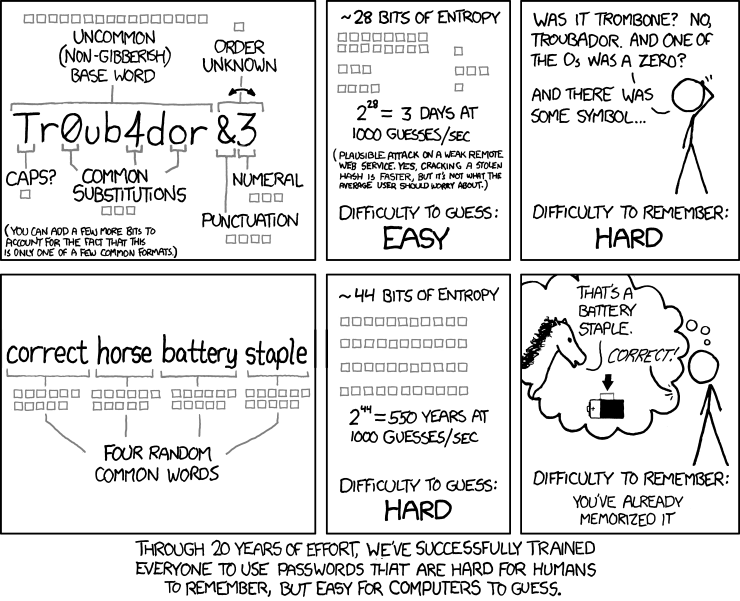
- (Recommended) You could use strong memorable passwords that are not difficult to type and enable autologin. Related xfcd comic:
- systemd-cryptenroll: For TPM usage, I highly recommend using secure boot. Though not sure if you can easily do that. A less secure alternative using systemd-cryptenroll would be use tpm2-pin and bind key to no pcrs (discouraged). But then you’ll have to use luks2 for encryption.
Notice from
man systemd-cryptenrollregarding tpm2-pin:
Note that incorrect PIN entry when unlocking increments the TPM dictionary attack lockout mechanism, and may lock out users for a prolonged time, depending on its configuration. The lockout mechanism is a global property of the TPM, systemd-cryptenroll does not control or configure the lockout mechanism. You may use tpm2-tss tools to inspect or configure the dictionary attack lockout, with tpm2_getcap(1) and tpm2_dictionarylockout(1) commands, respectively Also tpm2-pin is not disk encryption password and short alphanumeric password needed so tpm decrypts the device; so encryption password should be secured in a safe place. Also check if your distro supports systemd-cryptenroll.
-
usb drive: read previous comment
-
clevis: It probably isn’t as simple as systemd-cryptenroll but I guess you can use zfs and combine that with tpm2-pin if not using secure boot (discouraged).
You’ll have to make a compromise somewhere between security and convenience. Even if you use pam mount, you’ll have to enter the password, biometrics won’t do.
Edit: remove unnecessary user tag and add img uri
Thats how encryption works. Encryption with TPM protects against removing the drive and reading somewhere else, so I suppose it makes sense for most people.
Linux Distros have this option, Ubuntu has it now I think, but on the others its often manual setup.
Just search for “cryptsetup change to tpm”
You ended up with full disk encryption. For most people, it’s the simple option, everything is encrypted. That means the OS can’t start without the key, because you’re the only holder of the key. It’s both dead simple, and pretty bulletproof since there’s no way to access the system without the password. But as you said, not everyone wants that.
What you’re asking for is an encrypted home directory. It’s not that Linux can’t do it, it’s just not what you got. Depending on the use case you can either use TPM to unlock the root partition to boot, or not encrypt the system itself. Then when you log in, it decrypts a separate partition (or use ZFS native encryption, or use fscrypt if your filesystem supports it, or use an overlay filesystem like go-cryptfs).
So it’s not that Linux doesn’t support your use case but rather your distro doesn’t offer it as an installation option. From there you either configure it yourself (ArchWiki is great regardless of distro), or seek out a distro that does.
Linux is not an operating system, it’s just the kernel. What makes it an OS is what distros build on top of it. Linux alone is not that useful, hence the basis of the GNU+Linux memes: it’s Linux, plus a lot of GNU tools to make it do useful things, plus a desktop environment and a whole bunch of other libraries and applications, plus the distro’s touch tying it all together in a mostly cohesive experience.
deleted by creator
Fprintd is the only biometrics I know and hardware support is very limited. There are no easily accessible usb fingerprint readers either, which would allow easy testing and recommending.
I think if we could reverse engineer some kensington / etc. fprint sensor that would be huge.
deleted by creator
But I’m confused, the decryption of the home directory needs the owners secret to be entered at some point? I don’t see how this solves Op’s problem (which I also don’t understand, you want encryption, you need to decrypt stuff at some point)
Yes, the question is when and how.
You can enter it in the bootloader as a prerequisite to boot anything. You can also enter it at the display manager / login screen, which is a little further down the boot process.
My desktop for example can boot up to the login screen and perform its NAS and routing duties all on its own. But my user and all of my user’s data is still locked at that point: the computer is usable by guests and everything but even if you manage to throw a root exploit at it, my data is completely safe. Only when I log in, either locally or remotely, my password will go through PAM which will run a script that uses my password to unlock my home directory and mount it as I’m logging in.
What changes is what is covered by the encryption, and when the key is required. My root is auto unlocked via TPM, my home is unlocked on demand as I log in to my user account.
OP’s problem is they have full disk encryption so they need the password to boot up Linux at all, but they also get a second password prompt to log in when it reaches the display manager, even if it’s the same password. The solution is either they configure it to auto login since you need a password for the whole OS anyway, or they automate the unlocking of the root partition and use their login password to further decrypt the home directory (or rely entirely on the system being secure that the user isn’t encrypted further and it’s just a password prompt, which is what I think Windows does).
This reply isn’t going to be helpful to OP, but thought I might add context for others passing by.
I’m using Arch Linux with LUKS encryption and gdm. As long as my user’s password is the same as the LUKS password, I only ever type my password in once.
Just saying that a MacOS-like convenience is definitely possible on Linux.
Fascinating, you don’t have automatic login enabled? And I assume this is at the pre-login prompt?
Oof - forgot to mention that I do have autologin configured on gdm 😀
user’s password can be totally different from luks password if you’re using autologin. You can keep it same but that’s totally optional. You can login without entering any password at all if not using luks (or using autodecrypt), you can see that in live isos.
If you want to do away with any protection you have with opting in to a security measure, like typing in a password, why don’t you just reinstall and not select the encryption option?
Not requiring a password, or automatically entering a password to decrypt the filesystem, is essentially the same as not having encryption.
Decide which you want: Security or convenience. You cannot have both.
EDIT: Based on the responses I have to assume some of you guys live in windowless underground bunkers sealed off with concrete. Normal people don’t need perfect encryption they just want to add an extra hurdle or two for the crackhead who steals the PC. I assumed Linux had a system similar to what Windows or MacOS has been doing for a decade but I am apparently wrong.
I am sorry you were treated like this and downvoted for just asking for help without being a jerk at all.
There used to be exactly what you are looking for. Encfs, and later ecryptfs could encrypt just the data in your home folder.
It was a checkbox in ubuntu installer, just like the full disk encryption today. The key was protected by the standard user password.
Unfortunately, it was deprecated due to discovered security weaknesses, and I’m not aware of any viable replacement.
Systemd-homed does the same. But it is quite a huge change in the system, see this thread on the Fedora Discuss
Looks like it’s creating a new volume in a file, but I don’t see any type of quota being set upfront. If it scales up dynamically, it looks like a hot candidate. At this point I just hope distro maintainers settle down on something, anything, and give it a long term support.
Yes there is TPM for full disk encryption.
https://gist.github.com/orhun/02102b3af3acfdaf9a5a2164bea7c3d6#using-tpm-20
Do I had problem making swap partition work. As lockdown mode is triggered.
https://man7.org/linux/man-pages/man7/kernel_lockdown.7.html
I current only encrypted home.
I was kinda annoyed at double password login when I setup my system too. So what I did was just enable automatic login for my user since I’m the only one. I just treat my disk password as my login form so I just enter one password. I still have a user password for things like sudo and other permissions handling when I’m logged in but getting into a new session is automatic on startup so it doesn’t annoy me anymore. Would that work for you?
I think this is what I might have to do as I really don’t want to go back to Windows. I don’t suppose if you know if there is a way to lock the drive upon logging out? Or do I need to do a full shutdown every time.
I’m not sure LUKs can lock a drive that’s booted already since it’s not a RAM session like a live CD is and relies on the decrypted files to operate. This is why the encryption key is prompted from your boot manager prior to actually getting the system running. That said, I lock my computer all the time and just rely on the normal user password to get back in.
IIRC and I may be wrong here the drive stays encrypted in sleep. Decryption is done in real time via your CPU. However the encryption key is stored in unencrypted RAM. Which is why the other comment suggests encrypting swap and hibernating, this writes RAM to disk.
You dont want to do that.
What’s the point of encrypting something without a good passphrase? It defeats the whole purpose.
deleted by creator
Instead of encrypting the entire drive, encrypt the home folder. That way it’s unlocked when you sign in.