Why not? Companies that make pharmaceuticals, prosthetics, imaging devices, etc are all on the stock market too, so if hospitals weren’t on there, you could build a portfolio to approximate it by buying producers of medical equipment.
The real issue isn’t whether something is publicly traded, but collusion between groups to keep prices high. For example, it’s mutually beneficial for insurance, hospitals, and medical equipment providers to increase costs. Higher equipment costs means care providers can charge more (what’s another few hundred when the bill is in the thousands?), and higher total bills means insurance companies can charge higher premiums (they’re usually limited to a certain percent of cost as profit). Hospitals generally don’t have direct competitors since it’s prohibitively expensive to build one and there’s lots of bureaucracy based on “need,” so you can’t just go next door to an org that’s not involved in the collusion.
There are lots of viable solutions here, but banning them from the stock market isn’t going to solve anything. The first order of business imo is making everything more transparent.
I know it’s an anecdote, but I have a coworker that shared an experience moving from Canada to the US, and they said they much prefer the American healthcare system to the Canadian system. This is from the perspective of a relatively well off individual (not rich, just middle to upper middle class), so obviously someone at the bottom end of the income spectrum would have a different opinion.
So my question for people who promote socialized medicine is this: if you could easily afford both, would you prefer socialized or privatized medicine? And why?
I think we have a cost problem, not a structural problem, so we should look at ways of reducing cost before completely changing the structure of our healthcare system. My primary concern is getting insurance away from employers, publicly funding emergency services, and making hospital costs more transparent (e.g. publicly posted price ranges for common procedures). As in, reform the current system, not replace it.
know it’s an anecdote, but I have a coworker that shared an experience moving from Canada to the US, and they said they much prefer the American healthcare system to the Canadian system. This is from the perspective of a relatively well off individual (not rich, just middle to upper middle class), so obviously someone at the bottom end of the income spectrum would have a different opinion.
The problem is that healthcare systems are meant to take care of the entire population, not just the middle class or higher. If you are a moderately healthy and wealthy person, yes the American healthcare system is fine, but that’s not exactly the what your entire system should be geared for.
The only reason they like the system is because they are the bread and butter of private insurance. Healthy working adults whom don’t require lots of expensive care. However, if they were to developed a chronic illness, or get injured or I’ll to the point where they can’t maintain their employment… That’s when you get to experience the worst healthcare experience America has to offer.
if you could easily afford both, would you prefer socialized or privatized medicine? And why?
As someone who’s had socialized medicine (Tricare) and now currently has “good” private insurance (BCBS ppo), I definitely prefer socialized.
There’s no worry that your going to catch an unexpected co-pays, you aren’t nickle and dimed for every script or visit. No worrying about out of pocket maximums, yearly deductibles, or lack of specific coverage. You don’t have to get specialized insurance for just your eyes and teeth, the benefits go on and on.
I think we have a cost problem, not a structural problem, so we should look at ways of reducing cost before completely changing the structure of our healthcare system.
The cost problem stems from the structural problem. Private insurance steals the ability to effectively collectively bargain for lower prices. It also diverts funding away from the socialized insurance pool of Medicare, which lacks the young healthy subscribers that help stabilize and fund the care for elderly and sick.
Imagine if all the money that private insurance pockets went towards actually caring for people. Imagine if hospitals didn’t have to employ a small army of managers and billing agents, just to get paid for services already rendered. Imagine the collective bargaining power that we’d all have if pharmaceutical companies knew there was only one customer in the entire nation.
You give that all away for what? A policy that goes away the moment your employer decides they don’t want to pay that much this year? A policy that ties your physical well being to your employment? A policy that terminates your coverage the very moment you need it the most?
unexpected co-pays, you aren’t nickle and dimed for every script or visit
Again, you’re talking about cost, not which you’d prefer from a service perspective.
I think there are lots of opportunities to make costs lower, such as reducing patent lengths (reduces medication costs) and simplify insurance (reduces admin costs). We should also make changes to liability law so doctors can focus on providing care. Some specific proposals:
patents - reduce to 5-7 years; should cut costs of pharmaceuticals
insurance - simplify and standardize coverage; coverage details and bill processing should be automated
publicly post costs of common procedures, and give expected, average, and maximum costs before any procedure
And so on. And on top of that, expand Medicare/Medicaid a bit with costs phasing in the higher your income goes. I think we should also cap access to Medicare for retirees at a certain income level as well, and remove FICA tax caps.
We should absolutely be discouraging employer sponsored insurance and encouraging longer term insurance plans (e.g. like life insurance, you lock in at a lower rate if you sign up while healthy). Dropping someone from insurance shouldn’t be a thing at all, and the payout for doing so should be much higher than any costs the insurance company would incur by keeping them.
Again, you’re talking about cost, not which you’d prefer from a service perspective.
If you went to a restaurant and they ran separate charges every time you ordered something… You wouldn’t consider that bad service?
Also, I went to the same physician when on Tricare, so it’s the same exact service, minus all the billing hassle.
I think there are lots of opportunities to make costs lower, such as reducing patent lengths (reduces medication costs) and simplify insurance (reduces admin costs).
And I think you could do the same things and still lower the cost even more by banning privatized insurance?
Also, what is the profit motive for insurance companies to simplify their process? Their systems were purpose built to be as complicated and time consuming as possible, if they make the process easier, their subscribers would utilize it more, making insurance pay more often.
patents - reduce to 5-7 years; should cut costs of pharmaceuticals
insurance - simplify and standardize coverage; coverage details and bill processing should be automated
And again, why would corporations do this? And how would we enforce this?
The Medicare billing is automated, and pretty simple. It’s what every insurance company has the option of doing, but only Medicare and Medicaid have automated the process. This is because private insurance companies have no profit motive to pay for their prescribers healthcare.
publicly post costs of common procedures, and give expected, average, and maximum costs before any procedure
Most hospitals have this information available, especially if you call their financial services office. In fact if you are a Medicare patient this information is publicly available on the CMS website, and they list exactly how they came to that figure.
The whole hidden ledger thing is primarily only a problem at privatized hospitals that were bought or built by private hospital networks operating for profit.
I think we should also cap access to Medicare for retirees at a certain income level as well, and remove FICA tax caps.
The inherent problem with this is that the elderly are fundamentally uninsurable. You can’t make a profit from an elderly subscriber, the cost of their end of life care will always cost more than any subscription fee they may pay in.
This is why the vast majority of private insurance do not offer primary insurance to people older than 65. The whole point of private insurance is to extract money from healthy patients and then dump them onto Medicaid if they become disabled, or onto Medicare when they begin to age and decline in health.
We should absolutely be discouraging employer sponsored insurance and encouraging longer term insurance plans (e.g. like life insurance, you lock in at a lower rate if you sign up while healthy).
Who would offer those plans, and why? The only reason most people can afford private insurance is because their employer collectively bartered for the price. A lot of people have no idea how much of their employee compensation package is taken up by their insurance, but the burden of cost is redistributed by the entire employer pool.
Dropping someone from insurance shouldn’t be a thing at all, and the payout for doing so should be much higher than any costs the insurance company would incur by keeping them.
This would bankrupt private insurance companies…
I don’t think you fully understand how hard it is to make money on health insurance. The only way to do so is by withholding healthcare to your subscribers, or to offer plans with obscene co-pays or deductible.
The cost on average for full coverage is around 8.5k dollars a year for an individual, or 24k for a family. Meaning that the cost of a single operation, illness, or inpatient procedure will wipe away the potential profits from an individual subscriber for years. The only way to recover from having one I’ll subscriber is to balance them with a dozen healthy subscribers.
Without managing this equation of large healthy profitable pool vs small costly pool, the entire charade of private insurance would collapse upon itself.
One of the largest drivers in the increase in healthcare cost is these types of people. People whom don’t have any insurance, but still have healthcare needs. For these people the emergency room is typically their only option. This is one of the reasons emergency medicine is such a drain on hospital resources. For every person they treat without insurance, they have to raise the cost on people with insurance, simply so they don’t go out of business.
The real issue isn’t whether something is publicly traded, but collusion between groups to keep prices high. For example, it’s mutually beneficial for insurance, hospitals, and medical equipment providers to increase costs. Higher equipment costs means care providers can charge more (what’s another few hundred when the bill is in the thousands?
This isn’t how pricing is set for medical equipment… Nor is high equipment cost the reason behind the pricing increase.
Every hospital that accepts Medicare utilizes CMS guidelines when it comes to billing. Medicare sets the general price for items, factoring in things like historic pricing, cost of purchase from vendor, and the price of labour required to fit or make the device function.
The complex and expensive aspect of hospital billing stems from the introduction of private insurance companies. The ones that require more paperwork and processing time than Medicare, and will attempt to make the process as hard as possible.
Hospitals generally don’t have direct competitors since it’s prohibitively expensive to build one and there’s lots of bureaucracy based on “need,” so you can’t just go next door to an org that’s not involved in the collusion.
Because hospitals are a natural monopoly, not only are they prohibitedly expensive, but it’s also extremely hard to profit from them in the long term. Which is why there’s a large amount of bureaucracy to get them built.
Pretty much every ER room in America is a huge money sink that the rest of the hospital has to economically support. You add too many hospitals, and the services that are profitable get too spread across the area to support their individual ER operations.
Which is why about 10-15 years ago there was a large push from venture capital to build “hospitals” without trauma rooms. These hospitals began to eat up all the funding in the area and began shutting down hospitals with trauma wards. This is when a lot of states adopted legislation that would help curb this behavior.
There are lots of viable solutions here, but banning them from the stock market isn’t going to solve anything. The first order of business imo is making everything more transparent.
Banning private insurance is the only thing that would lower prices for Americans. None of the issues you covered are even close to the reason why things are getting expensive.
private insurance companies. The ones that require more paperwork and processing time
But what are those insurance companies processing? If you look at it, it’s “special deals” so the agents can get a bonus, it has nothing to do with actually saving their customers money. Hospitals inflate prices so they have room to make cuts so the insurance sales people feel like they’re winning.
The problem here isn’t with the nature of insurance, but the collusion between insurance companies and care providers. It’s a dance they play so everyone feels like they’re winning, and at the end of the day the customer is the one that loses. It’s not a competitive market, it’s a bureaucratic one where you have HR departments, insurance salespeople, and hospitals all propagating the current system because it’s lucrative for all of the middlemen.
Medical suppliers want a piece of the action too. That’s why we get things like insulin prices going up:
The high cost can be attributed in part to “evergreening,” a process in which drug companies make incremental improvements to their products that can extend the life of their patents, said Dr. Kevin Riggs, a physician at the University of Alabama at Birmingham Heersink School of Medicine. He co-wrote a study published in the New England Journal of Medicine in 2015 that described the century-long history of the drug.
They prevent competition through the patent and regulatory systems, and hospitals and insurance companies are fine with it because they just pass the costs on to the consumer. Consumers don’t really have a choice because most insurance comes from employers (who just pay employees less to compensate) or taxes (ACA subsidies). Nobody actually pays the full price, so the system continues.
The same goes on with medical devices, but volume is much lower so it’s easier to prevent real competition. Add to that the legal risk for choosing a cheaper product if anything goes wrong and you’ll find no incentive to cut costs.
Let’s assume we eliminate private insurance, you just change the private collusion to public collusion, and instead of middle managers getting paid in the public sector, you get political favors to keep prices high (e.g. campaign donations). Moving insurance from private to public just moves money from one pocket to another. The true solution here is to expose the collusion, not politicize it. If you want proof of this in action, look no further than the defense department in the US.
Pretty much every ER room in America is a huge money sink that the rest of the hospital has to economically support
Which is because of free riders. The solution to that problem is different: emergency care should be completely publicly funded. It’s so expensive because the hospital has to deal with people skipping on their bills and just move the costs to paying customers.
I think we should make ambulances and all non-elective care completely free, provided a paramedic recommends emergency care.
Natural monopolies aren’t intrinsically changed by demand…
But what are those insurance companies processing?
It’s not the insurance company that is doing the processing. It’s the hospitals, they have to hire more and more billing agents just to extract the money that the insurance has already agreed to pay.
special deals" so the agents can get a bonus
Lol, no. By “special deals” you mean 20% less than the Medicare allowable, and if you don’t agree then you are no longer in network.
Hospitals inflate prices so they have room to make cuts so the insurance sales people feel like they’re winning.
No, they inflate the prices so that when insurance companies ask for less money it doesn’t bankrupt the hospital.
The problem here isn’t with the nature of insurance, but the collusion between insurance companies and care providers.
You have no idea what you are talking about about… I’m a provider at a hospital, specializing in orthopedics and rehabilitation. I’ve never spoken to an insurance agent about pricing. That’s not how it works.
Medical suppliers want a piece of the action too. That’s why we get things like insulin prices going up:
Those are pharmaceutical companies, not medical suppliers, they are billed under completely different systems…
Also, the reason insulin pricing is so high is because Medicare isn’t allowed to barter for pricing, largely in part because it would be unfair to private insurance companies who have smaller subscriber groups.
we eliminate private insurance, you just change the private collusion to public collusion, and instead of middle managers getting paid in the public sector, you get political favors to keep prices high (e.g. campaign donations). Moving insurance from private to public just moves money from one pocket to another.
Oh yeah, I forgot how every medical system on the planet was completely fraudulent… Oh wait, nope, mainly just America.
The biggest way to improve pricing is by group bartering, which is how every other 1rst world nation pays less for medical equipment, treatment and prescription cost than the US.
Again, nothing you said was accurate, and anyone who takes it as so is now dumber than when they began reading. Please stop spreading misinformation about fields of study you do not specialize in.
Market competition is fine, but corporations are specifically obligated to focus on profits over other considerations, and in this case that is inappropriate and creates perverse incentives. Consider people like in the OP who have cynically bought in (or are in some retirement fund that bought in on their behalf) and now their financial wellbeing depends on hospitals continuing to be allowed to extract significant money out of people. Are they going to vote for candidates pushing actually effective measures to reduce how much people pay for medical care, if that means the stock will go down? Probably not.
I highly doubt OP actually did what they said they did, this was a SM post for publicity. Even if they did, they are absolutely in the minority, so there’s no reason to worry about public policy being impacted.
Because demand and supply don’t self-regulate healthcare. How much do you value your health? How about your own life? Oh, you’re willing to pay ANYTHING to live? Even if it’s not life threatening as long as it leaves you crippled, unable to work, you may as well be dead.
As a customer the only way to be an informed buyer is to be a physician yourself. Even if a treatment doesn’t work you still get charged, no refunds!
For-profit healthcare is fundamentally inhumane and is incompatible with capitalism. The forces that would usually regulate the market are non-existant. Demand is infinite, undercutting is pointless, customers have no way to be informed.
There’s a huge difference between emergency, life threatening care and relatively routine care. For example, if I need to get a tooth extracted, I can certainly wait to shop around a bit, and living with some pain for a few days could be worth finding a cheaper solution. I can also choose between hospitalization and self-care in many circumstances as well (e.g. normal baby delivery can happen at home or in the hospital).
For those cases where informed decisions are possible, supply and demand can work efficiently. It doesn’t work as well when there’s a monopoly on care, like in an ER, ambulances, etc.
And no, you don’t need to be a physician to be informed, you just need to consult one. I may not know the practical difference between operations, but I do understand chances of success and costs, and I know how to get multiple opinions and decide from there. That works for any field, I can convert a problem from needing an expertise to evaluating experts. Tell me what expected outcomes, the chances of various outcomes, and the costs, and I’ll get a second or third opinion if I’m not satisfied.
This gets even better the more transparent things are, because other experts can do independent reviews. A newspaper, for example, can hire a physician to review posted prices for routine operations and give an idea of how realistic those costs are. Insurance companies so exactly that, so I don’t see why a private organization couldn’t. News organizations routinely consult experts on stories.
But there are areas where there’s a monopoly, and those mess up the market’s ability to regulate prices. That’s why I’m in favor of universal coverage for emergency care, but against universal coverage for other forms of care.


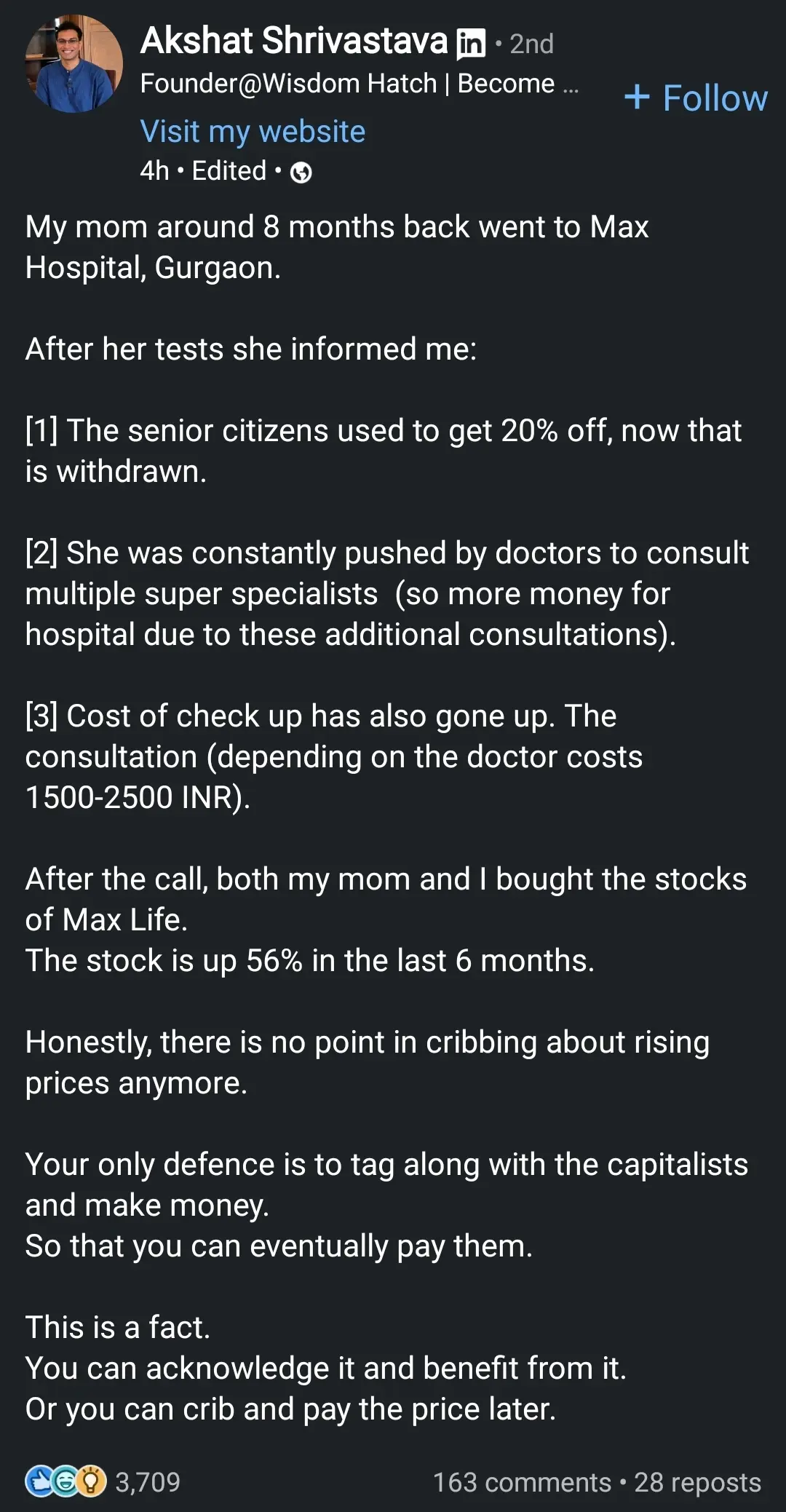
Why not? Companies that make pharmaceuticals, prosthetics, imaging devices, etc are all on the stock market too, so if hospitals weren’t on there, you could build a portfolio to approximate it by buying producers of medical equipment.
The real issue isn’t whether something is publicly traded, but collusion between groups to keep prices high. For example, it’s mutually beneficial for insurance, hospitals, and medical equipment providers to increase costs. Higher equipment costs means care providers can charge more (what’s another few hundred when the bill is in the thousands?), and higher total bills means insurance companies can charge higher premiums (they’re usually limited to a certain percent of cost as profit). Hospitals generally don’t have direct competitors since it’s prohibitively expensive to build one and there’s lots of bureaucracy based on “need,” so you can’t just go next door to an org that’s not involved in the collusion.
Here’s some YouTube videos about it:
There are lots of viable solutions here, but banning them from the stock market isn’t going to solve anything. The first order of business imo is making everything more transparent.
The real issue is the belief that essential services should make profit. Socialized, regulated Healthcare FTW.
I disagree.
I know it’s an anecdote, but I have a coworker that shared an experience moving from Canada to the US, and they said they much prefer the American healthcare system to the Canadian system. This is from the perspective of a relatively well off individual (not rich, just middle to upper middle class), so obviously someone at the bottom end of the income spectrum would have a different opinion.
So my question for people who promote socialized medicine is this: if you could easily afford both, would you prefer socialized or privatized medicine? And why?
I think we have a cost problem, not a structural problem, so we should look at ways of reducing cost before completely changing the structure of our healthcare system. My primary concern is getting insurance away from employers, publicly funding emergency services, and making hospital costs more transparent (e.g. publicly posted price ranges for common procedures). As in, reform the current system, not replace it.
The problem is that healthcare systems are meant to take care of the entire population, not just the middle class or higher. If you are a moderately healthy and wealthy person, yes the American healthcare system is fine, but that’s not exactly the what your entire system should be geared for.
The only reason they like the system is because they are the bread and butter of private insurance. Healthy working adults whom don’t require lots of expensive care. However, if they were to developed a chronic illness, or get injured or I’ll to the point where they can’t maintain their employment… That’s when you get to experience the worst healthcare experience America has to offer.
As someone who’s had socialized medicine (Tricare) and now currently has “good” private insurance (BCBS ppo), I definitely prefer socialized.
There’s no worry that your going to catch an unexpected co-pays, you aren’t nickle and dimed for every script or visit. No worrying about out of pocket maximums, yearly deductibles, or lack of specific coverage. You don’t have to get specialized insurance for just your eyes and teeth, the benefits go on and on.
The cost problem stems from the structural problem. Private insurance steals the ability to effectively collectively bargain for lower prices. It also diverts funding away from the socialized insurance pool of Medicare, which lacks the young healthy subscribers that help stabilize and fund the care for elderly and sick.
Imagine if all the money that private insurance pockets went towards actually caring for people. Imagine if hospitals didn’t have to employ a small army of managers and billing agents, just to get paid for services already rendered. Imagine the collective bargaining power that we’d all have if pharmaceutical companies knew there was only one customer in the entire nation.
You give that all away for what? A policy that goes away the moment your employer decides they don’t want to pay that much this year? A policy that ties your physical well being to your employment? A policy that terminates your coverage the very moment you need it the most?
Again, you’re talking about cost, not which you’d prefer from a service perspective.
I think there are lots of opportunities to make costs lower, such as reducing patent lengths (reduces medication costs) and simplify insurance (reduces admin costs). We should also make changes to liability law so doctors can focus on providing care. Some specific proposals:
And so on. And on top of that, expand Medicare/Medicaid a bit with costs phasing in the higher your income goes. I think we should also cap access to Medicare for retirees at a certain income level as well, and remove FICA tax caps.
We should absolutely be discouraging employer sponsored insurance and encouraging longer term insurance plans (e.g. like life insurance, you lock in at a lower rate if you sign up while healthy). Dropping someone from insurance shouldn’t be a thing at all, and the payout for doing so should be much higher than any costs the insurance company would incur by keeping them.
If you went to a restaurant and they ran separate charges every time you ordered something… You wouldn’t consider that bad service?
Also, I went to the same physician when on Tricare, so it’s the same exact service, minus all the billing hassle.
And I think you could do the same things and still lower the cost even more by banning privatized insurance?
Also, what is the profit motive for insurance companies to simplify their process? Their systems were purpose built to be as complicated and time consuming as possible, if they make the process easier, their subscribers would utilize it more, making insurance pay more often.
And again, why would corporations do this? And how would we enforce this?
The Medicare billing is automated, and pretty simple. It’s what every insurance company has the option of doing, but only Medicare and Medicaid have automated the process. This is because private insurance companies have no profit motive to pay for their prescribers healthcare.
Most hospitals have this information available, especially if you call their financial services office. In fact if you are a Medicare patient this information is publicly available on the CMS website, and they list exactly how they came to that figure.
The whole hidden ledger thing is primarily only a problem at privatized hospitals that were bought or built by private hospital networks operating for profit.
The inherent problem with this is that the elderly are fundamentally uninsurable. You can’t make a profit from an elderly subscriber, the cost of their end of life care will always cost more than any subscription fee they may pay in.
This is why the vast majority of private insurance do not offer primary insurance to people older than 65. The whole point of private insurance is to extract money from healthy patients and then dump them onto Medicaid if they become disabled, or onto Medicare when they begin to age and decline in health.
Who would offer those plans, and why? The only reason most people can afford private insurance is because their employer collectively bartered for the price. A lot of people have no idea how much of their employee compensation package is taken up by their insurance, but the burden of cost is redistributed by the entire employer pool.
This would bankrupt private insurance companies… I don’t think you fully understand how hard it is to make money on health insurance. The only way to do so is by withholding healthcare to your subscribers, or to offer plans with obscene co-pays or deductible.
The cost on average for full coverage is around 8.5k dollars a year for an individual, or 24k for a family. Meaning that the cost of a single operation, illness, or inpatient procedure will wipe away the potential profits from an individual subscriber for years. The only way to recover from having one I’ll subscriber is to balance them with a dozen healthy subscribers.
Without managing this equation of large healthy profitable pool vs small costly pool, the entire charade of private insurance would collapse upon itself.
One of the largest drivers in the increase in healthcare cost is these types of people. People whom don’t have any insurance, but still have healthcare needs. For these people the emergency room is typically their only option. This is one of the reasons emergency medicine is such a drain on hospital resources. For every person they treat without insurance, they have to raise the cost on people with insurance, simply so they don’t go out of business.
This isn’t how pricing is set for medical equipment… Nor is high equipment cost the reason behind the pricing increase.
Every hospital that accepts Medicare utilizes CMS guidelines when it comes to billing. Medicare sets the general price for items, factoring in things like historic pricing, cost of purchase from vendor, and the price of labour required to fit or make the device function.
The complex and expensive aspect of hospital billing stems from the introduction of private insurance companies. The ones that require more paperwork and processing time than Medicare, and will attempt to make the process as hard as possible.
Because hospitals are a natural monopoly, not only are they prohibitedly expensive, but it’s also extremely hard to profit from them in the long term. Which is why there’s a large amount of bureaucracy to get them built.
Pretty much every ER room in America is a huge money sink that the rest of the hospital has to economically support. You add too many hospitals, and the services that are profitable get too spread across the area to support their individual ER operations.
Which is why about 10-15 years ago there was a large push from venture capital to build “hospitals” without trauma rooms. These hospitals began to eat up all the funding in the area and began shutting down hospitals with trauma wards. This is when a lot of states adopted legislation that would help curb this behavior.
Banning private insurance is the only thing that would lower prices for Americans. None of the issues you covered are even close to the reason why things are getting expensive.
Not when there’s any kind of population density.
But what are those insurance companies processing? If you look at it, it’s “special deals” so the agents can get a bonus, it has nothing to do with actually saving their customers money. Hospitals inflate prices so they have room to make cuts so the insurance sales people feel like they’re winning.
The problem here isn’t with the nature of insurance, but the collusion between insurance companies and care providers. It’s a dance they play so everyone feels like they’re winning, and at the end of the day the customer is the one that loses. It’s not a competitive market, it’s a bureaucratic one where you have HR departments, insurance salespeople, and hospitals all propagating the current system because it’s lucrative for all of the middlemen.
Medical suppliers want a piece of the action too. That’s why we get things like insulin prices going up:
They prevent competition through the patent and regulatory systems, and hospitals and insurance companies are fine with it because they just pass the costs on to the consumer. Consumers don’t really have a choice because most insurance comes from employers (who just pay employees less to compensate) or taxes (ACA subsidies). Nobody actually pays the full price, so the system continues.
The same goes on with medical devices, but volume is much lower so it’s easier to prevent real competition. Add to that the legal risk for choosing a cheaper product if anything goes wrong and you’ll find no incentive to cut costs.
Let’s assume we eliminate private insurance, you just change the private collusion to public collusion, and instead of middle managers getting paid in the public sector, you get political favors to keep prices high (e.g. campaign donations). Moving insurance from private to public just moves money from one pocket to another. The true solution here is to expose the collusion, not politicize it. If you want proof of this in action, look no further than the defense department in the US.
Which is because of free riders. The solution to that problem is different: emergency care should be completely publicly funded. It’s so expensive because the hospital has to deal with people skipping on their bills and just move the costs to paying customers.
I think we should make ambulances and all non-elective care completely free, provided a paramedic recommends emergency care.
Natural monopolies aren’t intrinsically changed by demand…
It’s not the insurance company that is doing the processing. It’s the hospitals, they have to hire more and more billing agents just to extract the money that the insurance has already agreed to pay.
Lol, no. By “special deals” you mean 20% less than the Medicare allowable, and if you don’t agree then you are no longer in network.
No, they inflate the prices so that when insurance companies ask for less money it doesn’t bankrupt the hospital.
You have no idea what you are talking about about… I’m a provider at a hospital, specializing in orthopedics and rehabilitation. I’ve never spoken to an insurance agent about pricing. That’s not how it works.
Those are pharmaceutical companies, not medical suppliers, they are billed under completely different systems…
Also, the reason insulin pricing is so high is because Medicare isn’t allowed to barter for pricing, largely in part because it would be unfair to private insurance companies who have smaller subscriber groups.
Oh yeah, I forgot how every medical system on the planet was completely fraudulent… Oh wait, nope, mainly just America.
The biggest way to improve pricing is by group bartering, which is how every other 1rst world nation pays less for medical equipment, treatment and prescription cost than the US.
Again, nothing you said was accurate, and anyone who takes it as so is now dumber than when they began reading. Please stop spreading misinformation about fields of study you do not specialize in.
Market competition is fine, but corporations are specifically obligated to focus on profits over other considerations, and in this case that is inappropriate and creates perverse incentives. Consider people like in the OP who have cynically bought in (or are in some retirement fund that bought in on their behalf) and now their financial wellbeing depends on hospitals continuing to be allowed to extract significant money out of people. Are they going to vote for candidates pushing actually effective measures to reduce how much people pay for medical care, if that means the stock will go down? Probably not.
I highly doubt OP actually did what they said they did, this was a SM post for publicity. Even if they did, they are absolutely in the minority, so there’s no reason to worry about public policy being impacted.
Because demand and supply don’t self-regulate healthcare. How much do you value your health? How about your own life? Oh, you’re willing to pay ANYTHING to live? Even if it’s not life threatening as long as it leaves you crippled, unable to work, you may as well be dead.
As a customer the only way to be an informed buyer is to be a physician yourself. Even if a treatment doesn’t work you still get charged, no refunds!
For-profit healthcare is fundamentally inhumane and is incompatible with capitalism. The forces that would usually regulate the market are non-existant. Demand is infinite, undercutting is pointless, customers have no way to be informed.
There’s a huge difference between emergency, life threatening care and relatively routine care. For example, if I need to get a tooth extracted, I can certainly wait to shop around a bit, and living with some pain for a few days could be worth finding a cheaper solution. I can also choose between hospitalization and self-care in many circumstances as well (e.g. normal baby delivery can happen at home or in the hospital).
For those cases where informed decisions are possible, supply and demand can work efficiently. It doesn’t work as well when there’s a monopoly on care, like in an ER, ambulances, etc.
And no, you don’t need to be a physician to be informed, you just need to consult one. I may not know the practical difference between operations, but I do understand chances of success and costs, and I know how to get multiple opinions and decide from there. That works for any field, I can convert a problem from needing an expertise to evaluating experts. Tell me what expected outcomes, the chances of various outcomes, and the costs, and I’ll get a second or third opinion if I’m not satisfied.
This gets even better the more transparent things are, because other experts can do independent reviews. A newspaper, for example, can hire a physician to review posted prices for routine operations and give an idea of how realistic those costs are. Insurance companies so exactly that, so I don’t see why a private organization couldn’t. News organizations routinely consult experts on stories.
But there are areas where there’s a monopoly, and those mess up the market’s ability to regulate prices. That’s why I’m in favor of universal coverage for emergency care, but against universal coverage for other forms of care.