
With a black hole threatening to destroy Earth, humanity prepares for its final goodbye. But the scientist who first spotted it soon makes a surprising discovery.
This short story first appeared on a postcard (!) and then was included in two short stories collections.
Under 1-minute read.
<!–more–>
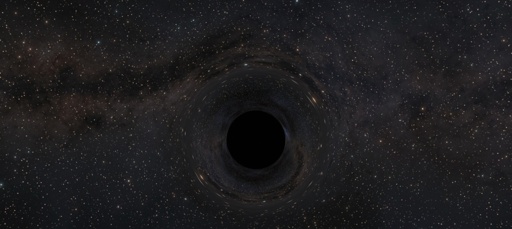
All of Earth waited for the small black hole to bring it to its end. It had been discovered by Professor Jerome Hieronymus at the Lunar telescope in 2125 and it was clearly going to make an approach close enough for total tidal destruction.
All of Earth made its wills and wept on each other’s shoulder, saying, “Good-bye, good-bye, good-bye.” Husbands said good-bye to their wives, brothers said good-bye to their sisters, parents said good-bye to their children, owners said good-bye to their pets, and lovers whispered good-bye to each other.
But as the black hole approached, Hieronymus noted there was no gravitational effect. He studied it more closely and announced, with a chuckle, that it was not a black hole after all.
“It’s nothing,” he said. “Just an ordinary asteroid someone has painted black.”
He was killed by an infuriated mob, but not for that. He was killed only after he publicly announced that he would write a great and moving play about the whole episode.
He said, “I shall call it Much Adieu About Nothing.”
All humanity applauded his death.
His introduction to this story in his anthology “The Winds of Change and Other Stories” is amazing.

The vagaries of the alphabet place the shortest story in the book at the very start. Just as well. You can read it in a minute and if you don’t like it, you can throw the book away. (Pay for it first, if you don’t mind.)
What happened was that back in 1975 I was asked to write a two-hundred-and-fifty-word story that could fit on a postcard.
The idea was to have “story-postcards” just the way you have “picture-postcards.” I obliged (since I am a most obliging fellow) and “About Nothing” was the result.
I don’t know what happened to the project. It probably failed. In any case, I finally offered “About Nothing” to /saac Asimov’s Science Fiction Magazine (which I will henceforth refer to as Asimov’s) and George Scithers, the editor, graciously condescended to smile upon it and to include it in the Summer 1977 issue of the magazine.
And here it is in another incarnation. If you haven’t seen it before, may you groan loudly.
I love this. The story did indeed make me groan 😅
Wonderful! I didn’t expect that at all. I should’ve researched the story more thoroughly; my post would’ve been twice as interesting with that trivia.
Edit: ill add it to my post, no reason to not include this.
Edit: done, TY.
I’ve had issues trying to look up stuff I know I’ve read in these before, so I would imagine not all is “digitized” or even talked about. Look at the stories in the Wikipedia page I linked, only a handful have pages.
So I don’t know if you’d get something like these nuggets. One of my favorite part of some of these anthologies are introductions, the perspective and their views are eye lifting.
We tend to forget that the pioneers of this genre coordinated by letter, or traveling in person to go talk. I take it for granted myself, I grew up with tech, I’m 37.
Asimov in a different one I probably won’t be able to find… talked about how difficult writing scifi is, especially when it first “started”. It was too risky for long from printing, so you were limited to short stories and usually magazine publications. The view of his, was how difficult that is with scifi specifically, because things can’t be “mundane”. A persona can’t just “turn a light switch” to turn the lights on, it needs to be fancy, and described. He attributed about 50% of his writing by word count was accommodating that.
Or something along those lines.
Right on. It explains so much about the origins of the genre.
Thanks for these nano-lettes
Heh

